So, do you need, or more importantly, want a Digital Single-Lens Reflex (DSLR) or a mirrorless camera?
Let’s start with a bit of history. The original Single-Lens Reflex cameras (without the “Digital,” of course) are almost a century old, although their peak popularity was between the 1960s and 1990s. They worked in a relatively simple way: light reflected from the subject travelled through the optics of an interchangeable lens to a mirror positioned between the mount and the film. Since that mirror sat at a 45 degree angle, the image bounced upward into a pentaprism and then into an OVF (optical viewfinder), where it finally reached the photographer’s eye:
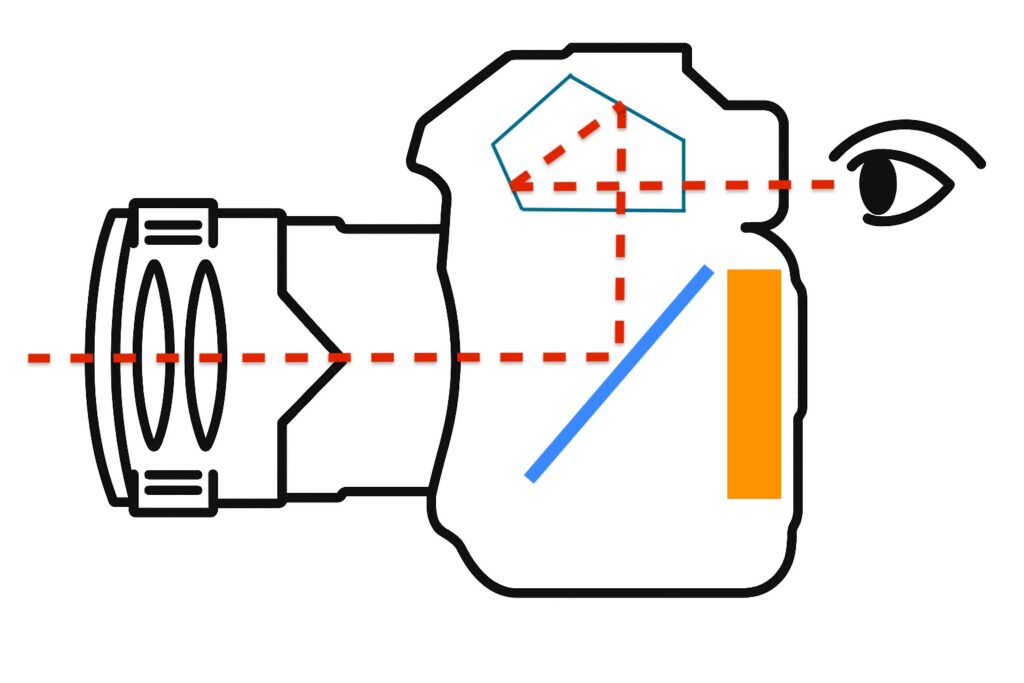
What happens when the shutter button is pressed? The 45 degree mirror flips up, the shutter opens, and the film is exposed to light according to the camera settings. That is the entire process.
When manufacturers added the “D” to “SLR” in the 1990s, the principle stayed the same. The viewfinder remained optical, but the film was replaced with an image sensor. Later models also included an LCD screen that displayed whatever the sensor captured. The engineering experience gained from building these components eventually led to further simplification of digital cameras.
Mirrorless cameras, as the name suggests, have neither a mirror nor a pentaprism. The viewfinder is electronic, and some people prefer using the rear screen instead of an EVF. You can adjust your settings and see the results in real time, so what you see on the screen or in the EVF is usually close to the final image. With no complex mechanical mirror assembly, the camera body becomes lighter and much smaller than a DSLR. That was the deciding factor for me. I am a big guy, and I cannot afford flying business class yet, so I went with a lighter and smaller gadget. The biggest drawback is that this lighter and smaller gadget needs more batteries (or a power bank, if your model supports USB-C charging). DSLR battery life is vastly superior to that of mirrorless cameras. And then there is personal preference, but I am not touching that topic with a 50 foot pole.
So, I have chosen my camera. Now what? It is time to explore the Magic Triangle of Photography, and then spend some time on lens construction and focal length.
Leave a Reply